According to Petra News on Tuesday, December 6, 2016, Her Majesty Queen Rania of Jordan attended a:
“…on the deteriorating performance of Jordanian students in the Trends in International Mathematics and Science Study (TIMSS), during a visit to the Mahes Secondary School for Girls in Al Balqa.
She also dropped by mathematics and science lessons taught by student-teachers enrolled in the Pre-service Professional Diploma Program implemented by the Queen Rania Teachers Academy (QRTA), who are currently fulfilling their practicum module at the same school.
During the workshop, attended by 50 educators and moderated by QRTA’s Dr. Ahmad Qublan, Queen Rania said that the latest TIMMS assessment results are an indication that school curricula and teaching techniques are lacking, and warned that generations should not have to pay the price until a satisfying development of Jordan’s education system is achieved.
Her Majesty said that change doesn’t happen overnight and urged teachers to propose ways to develop the education process in order help students apply what they learn to real life situations.
The Queen said that the TIMSS results were shocking because they revealed that most students are neither fully grasping what they are taught nor are they capable of employing their knowledge, especially in mathematics, which should rely on understanding and reasoning, rather than memorization.
She also explained that there are inexpensive and innovative ways to improve students’ performance through technology software that helps teachers better communicate information to students.
The Queen also noted that efforts are underway to establish a teaching college in cooperation with Jordan University that would be able to train a much a larger number of teachers before they start their teaching careers.
In response to comments by teachers who said that students do not take international exams seriously because they don’t factor into their school grades, Her Majesty said that ‘teachers and schools have to build the right environment that creates incentive in students to excel in any exam. Students should have the personal motivation to prove to themselves that they can do well in any exam, even if there is no direct return,’ Her Majesty added.
The performance of Jordanian students in last year’s TIMSS assessment has dropped drastically, placing Jordan 23 points below its rank in eighth grade Science. This constituted the largest drop by any of the 39 participating countries. Jordan’s score in eighth grade mathematics was also low, ranking 8th among nine participating Arab countries.
Teachers participating in the workshop expressed their frustration with the current science and mathematics curricula, on the grounds that they do not focus on the student’s understanding of the subjects and instead reinforce memorization rather than analysis. They also said they feel they lack effective teaching techniques that enrich students’ understanding based on reasoning, interpretation, and a logical thought process.
Some attributed the low TIMSS scores to lack of knowledge on the part of both teachers and students about the importance of this international assessment.
Several teachers told Her Majesty that they would like to see schools institute more extra-curricular activities that help students with problem-solving. Many, who have received training from QRTA, also called for establishing more education networks that can enhance their teaching techniques.
School Principal Mrs. Razan Zou’bi and Director of the QRTA Pre-service Professional Diploma Program Mrs. Suhair Alkhatib accompanied Her Majesty while she attended part of the classes taught by student-teachers enrolled in the diploma program.
QRTA’s diploma, a first in the kingdom, was launched in October 2016 under Queen Rania’s patronage, with the aim of preparing future educators to transform their classrooms into environments that encourage innovation, leadership, and intellectual curiosity.
The program’s first cohort of educators includes 185 teachers, who went through a highly competitive selection process.
The practicum segment, or ‘School Experience’ module, aims to improve the teachers’ professional standards and facilitate their entry into the profession.
QRTA aims to graduate between 5000 and 7000 students in the upcoming five years. Upon completion of the nine-month 24 credit hour diploma, student teachers will commit to a teaching job with the Ministry of Education for four years, and receive a monthly salary during the training period in accordance to its regulations.
The Mahes Secondary School for Girls, which was established in 1951 currently enrolls 783 students. The school welcomes the local community to use its facilities and services by providing a venue for workshops, holiday celebrations, religious activities, and The Mahes Annual Festival.”
On the evening of Tuesday, November 29, 2016, Her Majesty Queen Rania of Jordan received the Foreign Press Association’s Humanitarian Award in London, England.
Her Majesty was given the award in recognition of her “…extraordinary humanitarian work addressing the Syrian refugee crisis, and her active and compassionate role in promoting education and championing women…” according to the official website for the queen.
On Sunday, September 11, 2016, Her Majesty Queen Rania of Jordan was in Florence, Italy, where she received the Humanitarian Award from the Andrea Bocelli Foundation in recognition of her advocacy for refugees, children’s rights, and community empowerment.
Per a press release:
In her acceptance speech at the Gala dinner in Florence, the Queen referenced the transformations ushered by the 16th century Renaissance, calling for a new Renaissance ‘that drives humanity to give its best just when the stakes are highest.’
While praising Florence as the cradle of the Renaissance, which ushered in a progressive age of humanity, Queen Rania explained that the world desperately needs a new Renaissance that re-energizes the shared instinct for common decency and compassion, in order to “counter the ugliness of those forces that seek to wreak havoc on us.”
Highlighting the urgency required, Her Majesty described ‘forces at work’ as responsible for the violence perpetrated by extremists in Syria, Iraq, South Sudan, Nigeria, and beyond that are ‘determined to drag civilization back into the Dark Ages.’
‘They want us to live in a world of black and white, where the only color is the red of bloodshed,’ the Queen explained.
In a clear reference to Daesh, the Queen said their priority is to destroy the heritage, art, and any sign of civilization in the region.
Queen Rania mentioned the historic city of Palmyra in Syria and Iraq’s Nimrud as examples of these transgressions.
‘They have declared war on all civilization, but perhaps their most painful attack is that on the innocence of childhood. Like Omran Daqneesh,’ the Queen added.
She described the image of the injured Syrian boy in Aleppo that recently caught the world’s attention and went viral to illustrate the plight and suffering of Syrian refugees. ‘He sat in the back of an ambulance, dusty, dazed, and shell-shocked. So deeply traumatized, that not even the sight of his own blood fazed him. His silence screamed at the world. And the world had few words to offer back.’
Queen Rania stressed on the need to respond to this crisis by fighting the extremists and supporting refugees, who have had to bear the brunt of the conflict. She also pressed the audience to question whether ‘civilizations in ruin, and childhoods buried forever under the rubble of war and indifference”’should represent civilization’s legacy for future generations.
At the conclusion of her speech, Queen Rania urged the audience to work together across diverse backgrounds and cultures “to redefine a legacy that the world will still celebrate half a millennium from now.”
The Queen made these remarks at the Andrea Bocelli Foundation’s 3rd Italian edition of ‘Celebrity Fight Night,’ an event organized to raise funds for charities and recognize public figures for their humanitarian work.
The award has previously gone to George Clooney, Sofia Lauren, Lionel Richie, David Foster, Sharon Stone, and Reba McEntire. In 2014, the first Italian edition of Celebrity Fight Night in collaboration with the Andrea Bocelli Foundation raised over $6 million, two thirds of which were directed to the Foundation’s ongoing humanitarian work in Haiti.”
On Monday, September 5, 2016, Her Majesty Queen Rania of Jordan gave a speech during the launch of the National Strategy for Human Resource Development (NSHRD) conference held at the King Hussein Business Park in Amman, Jordan. Sitting in the audience including various Jordanian government officials, members of the Jordanian royal family including His Majesty King Abdullah II of Jordan.
According to the Jordan News Agency, the launch of the NSHRD “…paves the way for comprehensive development of human resources in line with applicable programs and plans.”
For those of you who do not understand Arabic here is what Her Majesty Queen Rania had to say in her speech:
“In the Name of God, the Almighty and Merciful
Assalamu Aleikum Wa Rahmatullahi wa Barakatoh (May Allah’s Peace, Mercy and Blessings Be Upon You)
Your Majesty, distinguished guests,
We are here today to discuss education; an often fiercely debated issue, except when it comes to its importance, which is never disputed… Because education touches every Jordanian household; each of us has a son or a daughter, a grandson or a granddaughter, a dear child or a relative, who goes to school every day.
We meet for their sake, not for the sake apportioning blame. The challenges our education system faces are numerous and complex; no one side is solely responsible for the problem, yet all of us have a responsibility to solve it.
Your Majesty,
The most important lesson you taught us is that the shortest way to resolve problems is to confront, not ignore, them. You taught us to see things as they are, because downplaying challenges will come at the expense of Jordan’s future generations, and that is something you would never accept. You constantly challenge us to raise our heads high so we don’t lose sight of the opportunities that are often hidden among challenges.
I realize that our current reality is difficult, and our surroundings more so. Still, I have great hope and great faith that we can turn the course of our history… Not through revolutions, aid, or the discovery of natural resources or even a buried treasure many dream of. The real treasure is all around us: there is no need to dig or search; it is in the minds of our children, and all we have to do is extract it.
Fortunately, today, talent is the most valuable commodity in the world. Knowledge, innovation, and technology are key ingredients to the success of any country, and we are no exception. Success is within our reach if we invest in education today, not tomorrow –because the only thing that stands between our present, and the future we aspire to, is ourselves.
Let us take the first step on the shortest path and examine our educational system with a critical eye. One hundred and fifty thousand children are enrolled in the first grade every year. What do we offer them? What does their journey within our education system look like?
Ninety percent of the development of the human brain occurs before the age of five, and yet in Jordan, only a small percentage of students have access to early childhood education: just two percent under the age of three, and roughly twenty-eight percent between the ages of three and five. One the other hand, the enrollment rates of their peers in the Organization for Economic Cooperation and Development (OECD) countries are multiples times higher.
Then comes their first day in primary school, a day of both anxiety and anticipation for children. Their parents encourage them, saying, “Those who don’t attend school will not learn, and “what will you be when you grow up if you don’t go to school?”
After the child trusts his parents’ reasoning, and the parents trust that their child, their most precious asset – and ours- will receive an education that fulfills their ambitions, the child carries his schoolbag, pens and notebooks and begins the primary school journey.
Gradually, lofty ambitions begin to fade in the face of the quality of education. Studies show that eighty percent of the second and third grade primary students underperform in reading… and that elementary school students in Jordan are falling behind in mathematics.
We get to the eighth grade, and we see that instead of improving, Jordan’s ranking has deteriorated in the last two cycles in the TIMSS International Mathematics and Science Assessment.
Then, in the tenth grade, we find Jordan ranking among the bottom ten countries in the Programme for International Student Assessment (PISA) on a list of fifty-six states.
As for the General Secondary Certificate (Tawjihi), despite efforts to improve it and elevate its status, the outcome remains unsatisfactory. Last year one hundred thousand students entered twelfth grade. Only sixty thousand of them sat for the secondary certificate exam, of whom only forty percent passed. This means that for every four students in the twelfth grade, less than one will graduate! And this year’s results reflected a similar pattern.
Every year we are shocked by news headlines like: “Not a single student from three hundred schools has passed!” I want to share with you an incident which I don’t like to remember but it is one that we should never forget. An empty Tawjihi exam paper was submitted with only this comment written on it by the examination hall supervisor: “the student is illiterate; he cannot read or write!”
A student spent twelve years in our schools and did not learn how to read and write!
Education reform is not easy, and it demands an unprecedented effort, in order to achieve unprecedented results. We must rethink structural issues such as education management, and introduce policies that bring highly qualified teachers into the teaching profession, and maintain their level of competence. Of equal importance are issues such as accountability and taking responsibility for poor educational outcomes.
Yes, the figures are shocking but, unfortunately, they make sense. What can we expect if less than ten percent of the Ministry of Education’s budget is allocated to the development of the educational process, compared to forty percent in a country like Finland?
What can we expect if fifty percent of our teachers chose this profession simply because it was the best or only available option to them?
What can we expect if only one-third of teachers in Jordan have specialized in education? The rest are leading classrooms today with degrees in science, mathematics or Arabic, but without any significant training in teaching methodologies.
We always say that teachers are the focal point of the educational process, but we have yet to make teachers the focal point of our attention. We place a burden of heavy responsibilities on them, without giving enough support to carry it. Despite that, we find them making every effort in the classroom for the sake of their students.
How can we expect our children to excel in today’s world if we don’t equip them with new technologies and access to the Internet from an early age? There are hundreds of schools in Jordan that aren’t connected to the Internet. Those that are, suffer weak connections and slow speed. That is why we are optimistic about efforts underway to complete the fiber optic network in the Kingdom, and insist on the importance of connecting all our schools.
We also cannot ignore the importance of what we teach our children. So, we must add our voices to the journalists and others who broke a taboo and spoke out on the need to reform a curriculum that has failed to produce graduates who have what it takes to succeed in the 21st century.
The goal of this presentation is not to push us into a dark hole without hope or light, or to describe an irreversible reality.
Change is difficult, but it’s not impossible. We have in our hands today a ten-year roadmap, which identifies the shortest and most effective paths to education reform. And here we are, moving forward. Our sincere gratitude to the National Committee for Human Resources Development for all their efforts.
Your Majesty, distinguished guests,
Jordan is not referred to as “the land of resolve” by chance. Rather, Jordanians have, over and again, shown that if they want to achieve something, they can. And we want quality education for our children; so let us start where we aspire to reach.
We want our children to work and compete in the 21st century; so let us equip our schools with technology and e-learning tools so that our students become fluent in the language of the century.
We want curricula that enrich learning and expand horizons of knowledge, so let us establish a curriculum center to implement the latest educational methods and curriculum development techniques – a model adopted by many top performing countries.
We want qualified teachers. That is why we are cooperating with the Ministry of Education, the University of Jordan and the Teachers’ Academy to establish a teacher education college to train teachers for one year before they enter the classroom. Only then can they lead their classrooms with confidence, equipped with the necessary knowledge and skills to teach Jordan’s young generations.
We will work with one of the best teacher training colleges in the world because we want the best education for our children, and the best training for our teachers.
There is no shame in drawing on international expertise, or in attracting talent wherever it may be to expand our knowledge. In our fast-changing world, there is no time to reinvent the wheel. Let us learn from those who have succeeded, and let us import the right expertise and capitalize on it. Let us use those foundations to build strong Jordanian institutions that are able to nurture generations with a global outlook and a strong Jordanian identity.
When we want, we can. That is why the most critical change we need is to break the mental molds and age-old limitations that have made our education system stagnant, rigid and incapable of keeping pace with changing times and growing ambitions. The toughest obstacles can only be overcome when we free ourselves from the high walls we have built within us, obscuring our vision and dreams.
The education we provide our children over the course of twelve years must be a journey that is worthy of their childhood, their time and their trust… A journey that begins with planting the seeds of life-long learning, so that they can grow with open and inquisitive minds.
Who here does not want that?
Education reform must be a national priority and a popular demand today, tomorrow and ten years from now.
In turn, our investments must mirror our priorities. Government spending on education must reflect the aspirations of Jordanians for quality education, so that we can take quick and confident strides towards the future we want, without fear or hesitation.
I have previously called for an education revolution, but Jordan cannot stand strong unless we all move together.
Ours is a country of strong institutions, and all of you here are decision-makers. Historical changes like the ones we’re are facing today require consensus and urgent unified action.
I hope that commitment to change today, does not morph into blame shifting tomorrow. Let me reiterate that we are not here today to throw blame, because that is a waste of time.
Your Majesty,
Distinguished Guests,
Let us fast forward ten years to the first week of school in 2026. We will find our children and grandchildren excited about going to schools that can realize their ambitions and ours.
We will see them greeted by teachers who are eager to provide them with knowledge, which they have worked hard to acquire and develop.
We will find their lessons alive with inquiry and self-expression. As for their curricula then, who knows what it will look like because with the constantly evolving education system we will develop, we won’t be able to predict today what our curricula will be a decade from now!
We will find Jordan ranking amongst the top ten countries in international assessments, and the day of Tawjihi results will be a day of national pride. It will be a day when one hundred and fifty thousand young men and women graduate feeling confident of their ability to find jobs they excel in and provide for their families.
What separates our reality now from that day, is consensus on education as a national priority, unwavering Jordanian resolve, and a commitment to a national strategy that can guide us out of this tunnel. Within the walls of this room and outside it, we have enough sense of responsibility, talent, and faith in education, to lead change and drive it forward. Let us commit and forge ahead towards an education system that meets ambitions of Jordan and its people.
May God bless you and may you, through your resolve, be an asset to the nation.
Walssalamu Aleikum Wa Rahmatullahi wa Barakatoh (May Allah’s Peace, Mercy and Blessings Be Upon You)”
Here is the documentary, Liebe zwischen den Fronten: Abdullah und Rania von Jordanien. The program is in German and unfortunately there are no sub-titles.
On the afternoon of Tuesday, January 12, 2016, Her Majesty Queen Mathilde of Belgium met with Her Majesty Queen Rania of Jordan at the Palais Royal in Brussels.
The purpose of the Her Majesty Queen Rania’s visit was to discuss the Syrian crisis as well as mobilizing international support for Jordan’s education system.
In a statement released by Her Majesty Queen Rania’s press office today’s meeting specifically focused on:
“…showcasing the struggles Jordanian citizens face in cities that are densely populated by Syrians. She highlighted the impact the crisis has had on Jordan’s resources, infrastructure, and especially schools, which have enrolled 150,000 Syrian students. This has affected the quality of education at schools that have been forced to run double shifts, with teachers under pressure to handle larger numbers of students in each class.
Her Majesty’s meetings are part of Jordan’s extensive efforts at all levels, ahead of the Syria’s Donor Conference in London on February 4 where, education will be a key theme.”
Click here to watch a video news report of Her Majesty Queen Rania’s meeting with the Prime Minister of Belgium, Mr. Charles Michel, and the President of the European Commission, Mr. Jean-Claude Junker.
On Monday, December 14, 2015, Her Majesty Queen Rania of Jordan attended the 10th Teacher Award and the 4th Principal Award ceremony held at the Royal Cultural Center-Al Hussein Youth City in Amman, Jordan. The ceremony was organized by the Association of Queen Rania Al Abdullah Award for Excellence in Education.
During this afternoon’s ceremony Her Majesty “…honored 25 winners, bestowing prizes and plaques to 15 teachers who won in five different categories, as well as 10 principals who won the distinguished principal awards in two categories…” according to Her Majesty ‘s press office.
The press release also notes that Her Majesty Queen Rania gave a moving speech highlighting:
“…the importance of recognizing teachers’ roles in building a more resilient and tolerant future generation. ‘Ten years ago, I launched the Teachers’ Award to start a tradition of recognizing outstanding educators whose skills reflect deeply on our success as a nation…’ Her Majesty said.
Queen Rania then continued, ‘I launched it for another reason, which few of you may not know… as it troubled me back then to learn that teachers felt unappreciated in our nation’s journey. And that is when I said: the era of teachers is back; believing in their role, I hoped they would reclaim their status and, once again, become a point of reference for all.’
‘Respecting teachers is a public social responsibility that is rooted first within homes, and then in classrooms, where capable teachers can earn students’ respect with their knowledge and experience…’ Queen Rania said. ‘Students must realize the importance of education before going to school; they must realize that that between their present and a promising future lies a school, an education, and a teacher…’ she added.
Referring to the pivotal role that a teacher plays in the face of turbulent times, she said, ‘we need our teachers more than ever… Our future depends on the next generation, their education, and the values they instill in them.’
‘Our young generation is being exposed to harmful new ideologies that neither our generation, nor previous ones, was familiar with —until today…’ she asserted.
Queen Rania went on to explain how discrimination is like a disease that takes advantage of vulnerable communities and spreads fear, adding that ‘…minds haunted by fear have no room for dreams. What future is one without dreams, hopes, and ambitions?’
Recalling the need to prepare youth to face alien ideologies, Queen Rania said, ‘We have to empower and raise them on the values of diversity and dialogue that Jordanians have passed on through the generations.’
‘We should teach them that they are part of a global community, one with more similarities than differences. Let’s teach children values that help them thrive, not ones that isolate and instill fear of the other…’ Her Majesty added.
Queen Rania concluded the speech by reaffirming that teachers are the country’s best chance at preparing a generation that will secure a better future for Jordan, congratulating educators for their commitment to this end.'”
 During the workshop, attended by 50 educators and moderated by QRTA’s Dr. Ahmad Qublan, Queen Rania said that the latest TIMMS assessment results are an indication that school curricula and teaching techniques are lacking, and warned that generations should not have to pay the price until a satisfying development of Jordan’s education system is achieved.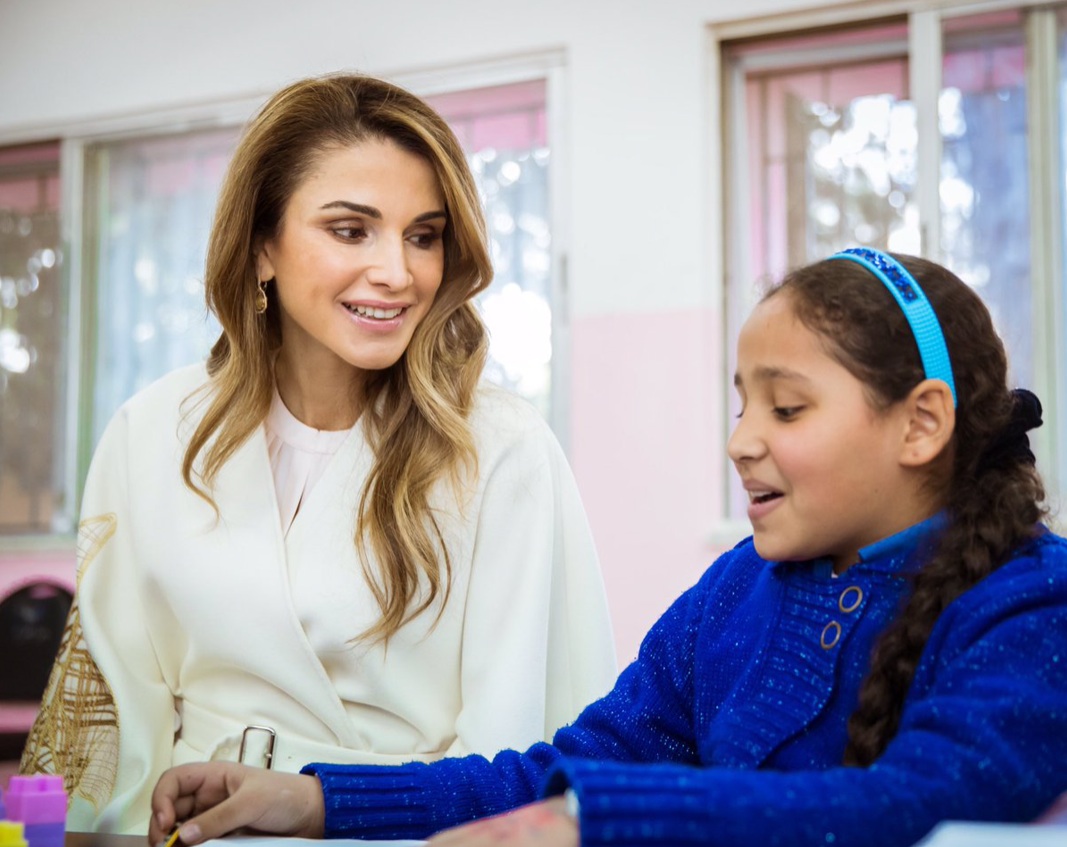
 The program’s first cohort of educators includes 185 teachers, who went through a highly competitive selection process.


 The Royal Correspondent