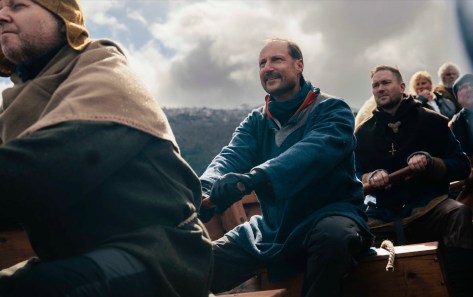
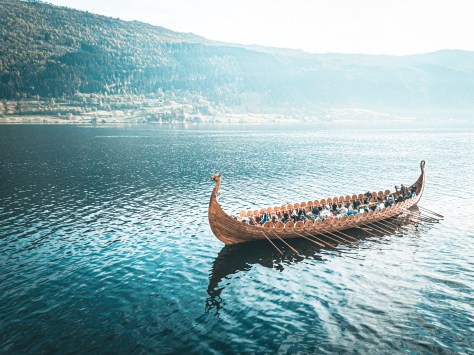
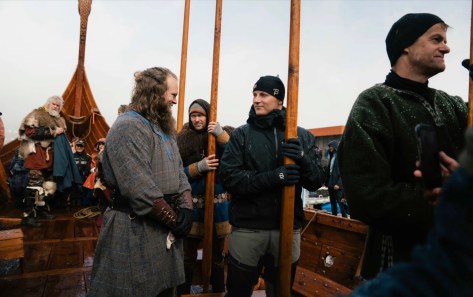
On Saturday, His Royal Highness Crown Prince Haakon of Norway, accompanied by his son, His Highness Prince Sverre Magnus of Norway, carried out an official visit to Nordfjordeid, in the municipality of Stad, where they attended the launch of the Myklebust ship.
The vessel is a full‑scale reconstruction based on archaeological remains uncovered during the excavation of the Rundehågjen burial mound on the Myklebust farm in Nordfjordeid in 1874. The investigation was undertaken by the Norwegian archaeologist Anders Lorange, who had been dispatched from Bergen after reports of a major burial mound, which prompted archaeological interest.
Mr. Lorange’s excavation revealed extensive evidence of a ship burial of exceptional scale. Within the mound, he identified a substantial layer of charcoal and ash, together with several hundred iron rivets and nails, establishing that a large seagoing vessel had been deliberately burned as part of a funerary rite.
Dated to the 9th century, the burial also contained weapons, shield fittings, and other high-status objects, indicating that the site formed part of an elite funerary landscape associated with regional power structures in western Norway during the Viking Age.
In what is regarded as a distinctive feature within the Scandinavian context, the Myklebust mound represents a cremation-based ship burial, in contrast to the inhumation ship graves more commonly preserved at other major Viking-age sites. It has long been regarded as one of the most significant archaeological monuments of its kind in Norway, and it remains a site of ongoing archaeological interest.
The reconstruction of the vessel reflects a combination of archaeological interpretation and traditional boatbuilding practices, forming part of broader efforts to present and reassess Norway’s maritime heritage. These efforts are also connected to ongoing work related to a potential nomination of the site for inclusion on the UNESCO World Heritage List.
The visit began at Sagastad, a knowledge centre dedicated to the Viking Age and the Myklebust discoveries, where they were briefed on the historical significance of the site and the process underlying the reconstruction.
The visit continued at the burial mound known as Rundehågjen, where representatives from the University of Bergen and local authorities provided an overview of both the original excavation and more recent archaeological investigations aimed at refining understanding of the site through modern methodologies.
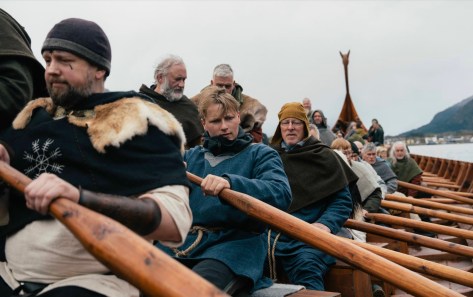
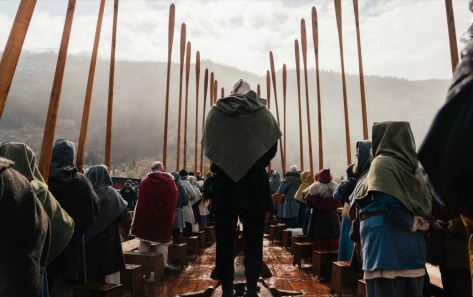
The reconstructed vessel, based on evidence from the 1874 excavation and subsequent research, was later launched onto the fjord. As part of the visit, the Crown Prince and the Prince joined members of a local rowing guild in rowing the vessel, participating in a demonstration of traditional seafaring practices associated with Viking-age vessels.

